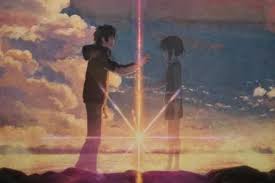
The Battle Against “Forgetting” — The True Message the Director Wanted to Convey
In Your Name., the memories of Taki and Mitsuha — who experienced the body-swapping phenomenon — begin to fade rapidly as time passes. Much like how we forget our dreams upon waking, the name, face, and feelings of the person who mattered most gradually dissolve into a hazy void.
This theme of “forgetting” is the most cruel thread woven throughout the film. That is precisely why the reunion scene five years later is far more than a simple happy ending.
Why the Final Scene Had to Take Place at Suga Shrine
Human beings are creatures who forget. No matter how precious a memory, it fades with time. Rather than portraying this nihilism as it is, director Makoto Shinkai chose to embed the message “even if we forget, there is a force that draws us back together” into the sacred ground of Suga Shrine — a place where the god of Musubi resides.
Even without memories, even without knowing each other’s names, the feeling of “I think I’ve met you somewhere before” — that is the thread of Musubi. The stone steps of the shrine were chosen as the place where that thread is finally tied once more.
The Artful Spatial Direction of Director Makoto Shinkai
Makoto Shinkai is renowned for his exceptional spatial storytelling as a filmmaker. The Suga Shrine scene is layered with numerous cinematic devices.
① From Passing Trains to the Stone Steps — A Relay of Fate
The final scene begins when the now-employed Taki spots Mitsuha through the window of a passing train. Their eyes meet for just a moment, and both step off their trains to search for each other.
Filled with a growing sense of urgency — “where did that person go?” — Mitsuha is drawn up the stone steps while Taki stands waiting below. This spatial journey of “train → city streets → stone steps” represents a gradual movement from the everyday world into the realm of Musubi.
② The Contrast of Light and Shadow
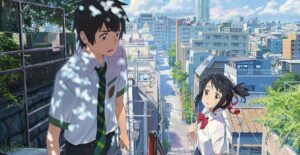
In the film’s animation, the Suga Shrine scene is bathed in soft afternoon light. The composition, in which the two figures emerge against the shadow-draped steps, expresses the boundary between the ordinary and the extraordinary through the play of light itself.
The luminous, particle-rich visual beauty that defines Shinkai’s work serves to visually consecrate the “sacredness” of Musubi in this pivotal moment.
③ The Power of Silence — Space Created by Minimal Dialogue
The dialogue exchanged by the two in the reunion scene is remarkably sparse. “Excuse me… have we met somewhere before?” — and that is all.
No words are needed to bridge five years of absence. By keeping the dialogue to a minimum, the film is designed so that each viewer can fill in “what happened between these two” within their own heart. This artful use of silence is the very essence of Makoto Shinkai’s craft.
Mapping the Musubi Structure of Your Name.
The concept of “Musubi” that runs through the entire work functions across three layers: story, visuals, and music. The table below offers a structured overview.
| Layer | Specific Expression | Correspondence with Musubi |
|---|---|---|
| Story | Body-swapping, the comet’s orbit, braided cord | The power of Musubi connecting time and people |
| Visuals | The stone steps of Suga Shrine, the up/down composition, use of light | Boundary between sacred and human worlds = the meeting point of Musubi |
| Music | RADWIMPS soundtrack | Emotional Musubi — connecting the audience to the film |
| Language | Words such as “Musubi,” “kumihimo,” “kataware-doki” | Verbalizing the concept and connecting the audience’s understanding |
Why Do We Cry at That Final Scene?
The reason audiences around the world shed tears at that final scene is not simply because it is beautiful as a romance.
Everyone has had the experience of forgetting something precious in the course of daily life. A childhood dream, someone you truly loved, a view you never wanted to forget. Human beings forget what matters most with a startling ease.
And so, in the image of two people who are still drawn to each other despite the forgetting, who still feel “something about that person stays with me,” and who meet again on a flight of stairs, we each superimpose our own “precious things we have forgotten.”
Key Points of This Analysis
Suga Shrine was not chosen merely as a filming location — it was inevitably chosen as a sacred place where the god of Musubi resides. The symbolic meaning of the up/down composition on the steps, the boundary between the sacred realm and the human world, and the power of Musubi to overcome forgetting — all of these are concentrated in a single flight of stone stairs.
Feeling “Real Musubi” Through Pilgrimage
When you actually visit the stone steps of Suga Shrine, not only does the emotion of the film come flooding back, but a strange sense of reality wells up — “so this is where those two finally met.”
Is not the act of pilgrimage itself a kind of “Musubi” connecting the film to reality? The experience of standing at the intersection of a fictional world and a real physical space is precisely the moment where you feel firsthand the “power to connect time and people” that Makoto Shinkai set out to depict.
Visitor Etiquette
Suga Shrine remains an active place of worship where local residents visit regularly. When making a pilgrimage, please be mindful of the community around you. Visiting quietly and with a spirit of respect is, in the truest sense, the right way to feel the presence of Musubi.
| Item | Details |
|---|---|
| Shrine Name | Suga Shrine (須賀神社) |
| Address | 5 Sugacho, Shinjuku-ku, Tokyo |
| Nearest Station | Yotsuya-sanchome Station (Tokyo Metro Marunouchi/Namboku Line), approx. 7 min. walk |
| Visiting Hours | Grounds open at all times (shrine office approx. 9:00–17:00) |
| Photography Etiquette | Please keep noise to a minimum. Large equipment such as tripods requires extra consideration. |
In Conclusion: What the Stone Steps of Suga Shrine Teach Us
- Suga Shrine is a sacred place where the god of Musubi (Musubi no Kami) resides — making it the inevitable setting for the reunion
- The “upper (sacred realm)” and “lower (human world)” composition of the steps symbolizes the intersection of time and destiny
- The astronomically unlikely meeting of the two can be understood as the work of Musubi
- The final scene carries a message of hope: “overcome forgetting, and this time, truly connect”
- Shinkai’s spatial direction, use of light, and restrained dialogue combine to create the film’s profound emotional impact
- The act of pilgrimage itself is a modern-day Musubi connecting the film and reality
If you found this article helpful, please consider sharing it on social media.
More analysis articles on Makoto Shinkai’s works are coming soon.





コメント