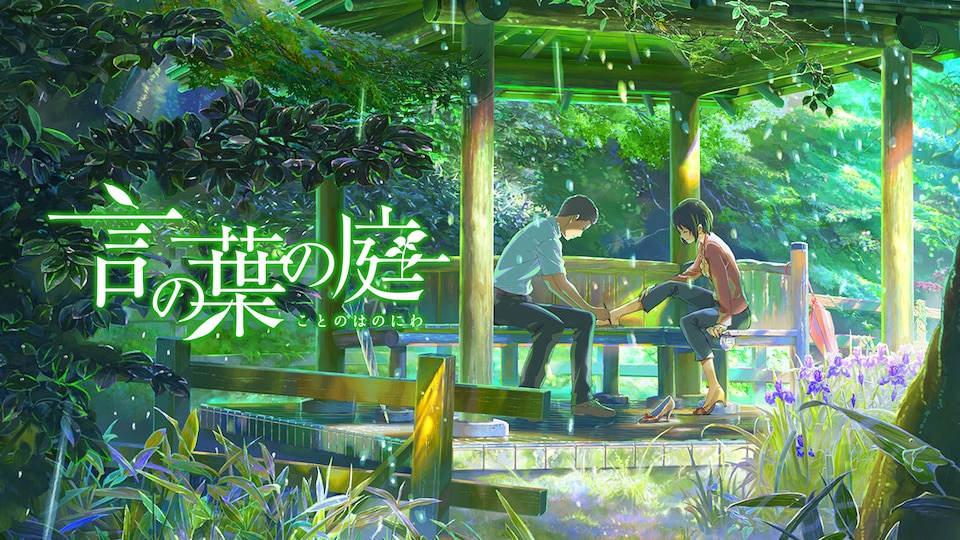
Anime Film Review & Deep Dive
The Garden of Words (言の葉の庭)
Makoto Shinkai’s Most Poetic Film — A Complete Review & Analysis
Directed by Makoto Shinkai | 2013 | CoMix Wave Films / Toho | 46 minutes
Imagine a rainy Tuesday morning in Tokyo. You duck into Shinjuku Gyoen — one of the city’s grandest national gardens — to escape the noise of the world and find yourself sitting on a wooden bench under a pergola, watching raindrops shatter the surface of a still pond. Across from you sits a stranger. Neither of you says a word. Yet somehow, something passes between you.
That is the emotional universe of The Garden of Words (言の葉の庭, Kotonoha no Niwa), the 2013 animated drama from director Makoto Shinkai. In just 46 minutes — a runtime shorter than most Hollywood trailers put end-to-end — Shinkai conjures one of the most visually ravishing, thematically rich, and emotionally complex anime films ever made.
In this article, we take a thorough look at everything that makes The Garden of Words a landmark of contemporary animation: its story and characters, its stunning visual style, its philosophical themes rooted in classical Japanese poetry, its music, and its place within Shinkai’s broader body of work. Whether you are watching for the first time or revisiting it years later, this deep dive is for you.
Quick Facts at a Glance
| Detail | Information |
|---|---|
| Japanese Title | 言の葉の庭 (Kotonoha no Niwa) |
| Director / Writer / Editor | Makoto Shinkai |
| Animation Studio | CoMix Wave Films |
| Distributor | Toho |
| Release Date | May 31, 2013 (Japan) / April 28, 2013 world premiere (Gold Coast Film Festival, Australia) |
| Runtime | 46 minutes |
| Voice Cast (Japanese) | Miyu Irino (Takao) · Kana Hanazawa (Yukari) |
| Composer | KASHIWA Daisuke |
| Theme Song | “Rain” — originally by Senri Oe (1988), performed for the film by Motohiro Hata |
| Budget | Approx. ¥150 million (~$1.3 million USD) |
| Awards | 2013 Kobe Theatrical Film Award · Fantasia International Film Festival (Satoshi Kon Award + Audience Award) · 2014 AniMovie Award (Stuttgart) · Daruma Best Screenplay, Japan Expo Awards 2016 |
| Adaptations | Manga (art: Midori Motohashi) · Novel (written by Shinkai) · Stage play (London 2023, Tokyo 2023) |
The Story: Two Strangers in a Rain-Soaked Garden
The Garden of Words unfolds across the rainy season in Tokyo — roughly May through July — and is set almost entirely within the verdant grounds of Shinjuku Gyoen National Garden, one of the largest and most celebrated green spaces in the Japanese capital.
Our protagonist is Takao Akizuki, a fifteen-year-old first-year high school student with a singular, unusual dream: he wants to become a shoemaker. On rainy mornings, instead of attending his first class, Takao slips away to a quiet pergola in Shinjuku Gyoen to sketch shoe designs in his notebook, relishing the solitude that the rain provides.
One morning he finds the pergola already occupied. Seated there is Yukari Yukino, a twenty-seven-year-old woman who, for reasons she refuses to share, is also skipping — her workplace, it turns out. She drinks beer and eats chocolate for breakfast, a small act of rebellion against a life that seems to be quietly crumbling around her. When she notices the school crest on Takao’s uniform, she bids him farewell with a cryptic tanka — a classical Japanese poem of thirty-one syllables — before walking away, leaving him both puzzled and captivated.
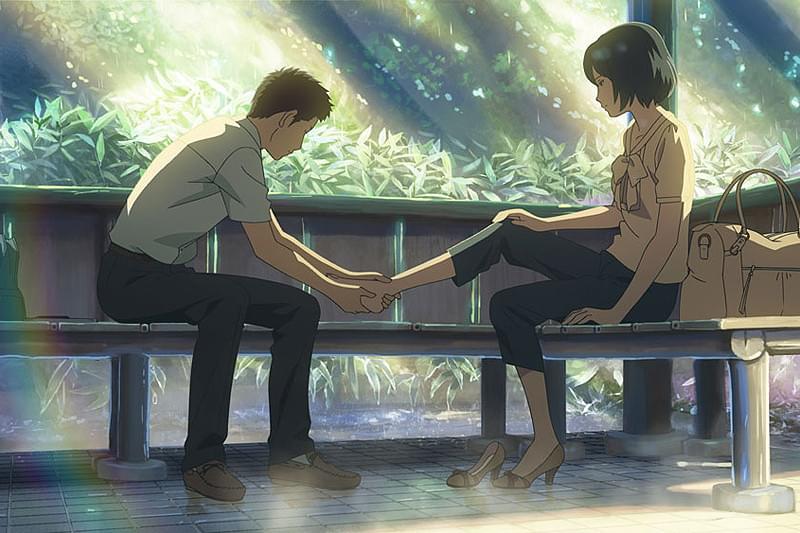
From that morning onward, the two keep returning to the same pergola on rainy days. They share food, conversation, and long silences. They never exchange names. Takao learns that Yukari has an interest in his shoemaking ambitions, and so he decides — with the meticulous dedication of an artisan — to make a pair of shoes precisely fitted to her feet.
As the weeks pass, their connection deepens into something neither of them has words for. And then, in the cruelest way possible, the world outside the garden intrudes. When summer arrives and the rains stop, so do their meetings. Takao returns to school after summer break to discover that Yukari is — or was — a literature teacher at his high school. She had been driven away by student bullying. The truth of who she is, and what she has been running from, transforms their quiet companionship into something raw and urgently felt.
The film culminates in a scene of startling emotional release — a catharsis that arrives fast and hits hard — before settling into a quietly hopeful denouement. Takao resolves to pursue his dreams. Yukari, no longer hiding, begins to walk forward again. And the shoes he made for her become the film’s most potent symbol: a promise that someone saw her, truly, and wished to help her walk.
Characters: Two People Learning How to Walk
Takao Akizuki — The Boy Who Makes Shoes
Takao is an unusual protagonist for a romance film. He is not brooding or rebellious in a conventional teenage sense. He is quiet, focused, and mature far beyond his fifteen years. His passion for shoemaking sets him apart from his peers and gives the film one of its central metaphors.
Takao’s home life is somewhat chaotic — his mother is largely absent, and he largely fends for himself and his older brother. This independence has made him self-reliant and introspective. He finds in Yukari not a romantic fantasy but something rarer: a person who listens, who seems to need his presence as much as he needs hers.
Voiced with understated vulnerability by Miyu Irino (also the voice of Haku in Spirited Away), Takao feels entirely real. His emotions never tip into melodrama. Instead they simmer — until, in the film’s climactic moments, they finally boil over with devastating sincerity.
Yukari Yukino — The Woman Who Could Not Walk
Yukari is the film’s most complex and perhaps most heartbreaking creation. A classical Japanese literature teacher, she was once a person who found beauty in language — in the ancient poems of the Man’yōshū, Japan’s oldest anthology. But workplace bullying orchestrated by students who spread false rumours has left her unable to set foot in the school. She has retreated into the garden, into beer and chocolate, into the company of a boy who asks nothing of her.
Voiced by the luminous Kana Hanazawa (known internationally for roles in Steins;Gate and Your Name), Yukari carries a quiet dignity that coexists with visible fragility. There is something deeply poignant in the image of a woman who teaches words for a living and yet cannot speak the truth of her own life. It is only with Takao — outside the structures and hierarchies that have crushed her — that she can breathe.
Her arc is one of the most affecting in Shinkai’s filmography: a woman who has lost the ability to walk through the world on her own terms, slowly, tentatively, learning how to do so again.
Character Overview
| Character | Age | Voice Actor (JP) | Key Trait |
|---|---|---|---|
| Takao Akizuki | 15 | Miyu Irino | Aspiring shoemaker; quietly determined, emotionally mature |
| Yukari Yukino | 27 | Kana Hanazawa | Literature teacher on leave; wounded, searching for a reason to move forward |
Themes: Loneliness, Longing, and the Ancient Meaning of Love
Koi — Lonely Sadness as the Root of Love
The film’s intellectual heart lies in a meditation on language itself. Director Shinkai was inspired by the Man’yōshū (万葉集), Japan’s oldest extant poetry anthology, compiled in the eighth century. Within that tradition, the word most associated with romantic feeling is not ai (愛) — the modern word for love — but koi (恋).
In classical usage, koi was written with kanji that carried connotations of solitude and longing: a reaching toward someone or something across a distance that may never be fully closed. It is love not as consummation but as yearning. Not as union but as the poignant awareness of separation.
This is, Shinkai has said, the exact emotional register he set out to capture in The Garden of Words. The film is a story about koi in its original, most honest sense — about two lonely people whose connection makes the world more bearable without resolving their solitude. Their relationship exists beautifully precisely because it has not yet become anything definable.
Shoes as a Metaphor for Walking Through Life
Shinkai himself has spoken about the central metaphor of shoes. To make shoes for someone is, in the logic of this film, to help them walk. And to walk is to move through the world, to continue living, to take the next step when the step before has broken you.
Yukari, battered by professional and social trauma, has lost the ability to walk — figuratively, but also almost literally. She cannot walk into the school where she once taught. She is paralysed. The shoes Takao crafts for her, measured to her precise dimensions with extraordinary care, are an act of profound attentiveness. They say: I see you. I know your shape. I want you to be able to move again.
When she finally puts them on in the film’s closing moments, the symbolism is both quiet and immense.
Rain as Sacred Space
Rain in The Garden of Words is not mere weather. It is the condition that makes everything possible. Rain empties the garden of crowds, creates a cocoon of privacy, and gives both characters a socially acceptable reason to be elsewhere — away from school, away from work, away from the worlds that have failed them.
But rain is also traditionally a symbol of renewal and cleansing in Japanese culture. The rainy season (tsuyu) is a liminal time — neither spring nor summer — when the ordinary rhythms of life slow and something dreamlike becomes possible. Shinkai locates his story here with deliberate precision. Their relationship is itself a kind of rain: temporary, atmospheric, life-giving, and destined to end when the sun returns.
The Age Gap — Awkward Maturity and Uneven Growth
The twelve-year age difference between Takao (15) and Yukari (27) is one of the most discussed — and debated — aspects of the film. Shinkai’s intention, as expressed in interviews, was to use the age gap not for romantic titillation but to illustrate how disjointedly people mature. Takao, at fifteen, is in many ways more emotionally grounded than Yukari at twenty-seven. The gap between their ages is less significant than the gap between where each of them stands in life.
The film does not shy away from the fact that Takao develops romantic feelings for Yukari. It presents those feelings honestly and without judgment. But it also makes clear that Yukari’s position — as a teacher, as an adult — means she cannot and does not reciprocate in kind. The emotional climax of the film is built precisely on this impossibility. What they share is real. What they cannot be to each other is also real. Both things coexist, painfully and beautifully.
Visual Style: Animation That Feels Like a Dream
Even among Shinkai’s other visually extravagant works — including Your Name (2016) and Suzume (2022) — The Garden of Words stands apart for the sheer painterly density of its imagery. The animation was produced by CoMix Wave Films with Kenichi Tsuchiya as animation director and Hiroshi Takiguchi as art director.
Water is the film’s defining visual element. Shinkai and his team rendered rain with a level of precision that had never been seen in anime before. Individual drops catch the light. Puddles spread and ripple with exact fluid dynamics. The surface of the garden’s pond holds reflections that shift with every passing cloud. To watch this film is to feel genuinely wet.
The garden itself — Shinjuku Gyoen, drawn from location scouting Shinkai conducted personally — is depicted with extraordinary botanical specificity. Every tree, every leaf, every patch of moss is rendered with loving attention. The contrast between the hyper-real green of the garden and the grey geometry of the surrounding Tokyo cityscape is one of the film’s most powerful compositional choices. Nature and metropolis coexist here not in conflict but in an uneasy, beautiful balance.
Light is handled with equal mastery. The film makes heavy use of lens flare, bloom effects, and delicate pink-gold tones that give even overcast scenes an inner luminosity. Scenes inside the garden often feel as though the light itself has become tactile — as though you could reach out and hold it.
The visual philosophy connects directly to the film’s emotional themes. In Shinkai’s aesthetic, beauty and impermanence are inseparable. The more ravishing a moment looks, the more clearly we understand that it cannot last. Every gorgeous frame of rain is also a reminder that the season will end.
Music & Sound: KASHIWA Daisuke’s Atmospheric Score
For The Garden of Words, Shinkai made a significant departure: instead of longtime collaborator Tenmon, who had scored his previous films, he chose KASHIWA Daisuke, a musician associated with post-rock and electroacoustic composition.
The result is a soundtrack that feels as carefully textured as the animation itself. KASHIWA’s score uses layered strings, piano, and subtle electronic processing to create music that seems to exist in the same physical space as the rain — ambient, immersive, atmospheric rather than melodically dominant. The music does not tell you how to feel. It creates a space in which you feel.
The film’s theme song, “Rain,” was written and originally performed by Senri Oe in 1988. For the film, it was rearranged by Makoto Minagawa and Akifumi Tada, and performed by Motohiro Hata. The song plays over the film’s closing sequence with perfect emotional timing — a gentle, bittersweet melody that arrives exactly when the viewer most needs permission to exhale.
Sound design is equally meticulous. The sound of rain in this film — its texture, its rhythm, its varying intensity from light drizzle to heavy downpour — is as expressive as any piece of dialogue. Shinkai has always understood that silence and ambient sound can carry emotional weight that words cannot.
The Poetry: Tanka from the Man’yōshū
Classical Japanese poetry plays a central structural role in the film. When Yukari first encounters Takao, she bids him farewell with a tanka — a poem of five lines and thirty-one syllables, one of the oldest literary forms in Japan:
“A faint clap of thunder / Clouded skies / Perhaps rain will come / If so, will you stay here / With me?”
Takao does not understand where the poem comes from. He spends time researching it — an act that deepens his connection to Yukari even before he knows her name. The poem, drawn from the Man’yōshū and linked to a Kaoru Kurazumi’s scholarly consultation, speaks of anticipation, of the wish for someone to linger, of the beautiful uncertainty of rain.
Late in the film, Takao responds — unknowingly, having discovered the poem’s companion verse — with:
“A faint clap of thunder / Even if rain comes or not / I will stay here / Together with you.”
The fact that two strangers unknowingly exchange two halves of the same ancient poem is the film’s most magical narrative device. It suggests that some connections are written before they happen — that language itself can reach across centuries to bring two isolated people together.
Yukari, as a literature teacher, understands immediately what Takao has said. And in that moment, everything between them shifts.
Production & Release: An Unconventional Debut
Production on The Garden of Words began in spring 2012. Shinkai conducted location scouting personally around Shinjuku Gyoen, photographing light conditions, architectural details, and plant life with the obsessive attention to accuracy that defines his approach. The entire film was completed in approximately six months on a budget of roughly ¥150 million — an extraordinarily modest sum by the standards of theatrical animation.
The film had an unusual release strategy. It premiered internationally at the Gold Coast Film Festival in Australia on April 28, 2013, weeks before its Japanese release. In Japan it opened on May 31, 2013 — but was simultaneously made available digitally on iTunes on the very same day. Its Blu-ray and DVD were released on June 21, 2013, while the film was still in theatrical release. This bold approach to simultaneous windowing was innovative for its time and helped the film reach audiences far beyond the traditional theatrical footprint.
The gamble paid off: The Garden of Words ranked highly on the iTunes Store throughout 2013 and was named the Year’s Best Animation in iTunes’ Best of 2013. It has since been licensed for North American distribution by Sentai Filmworks, by Anime Limited in the UK, and by Madman Entertainment in Australia.
Awards & Critical Reception
| Award | Year | Result |
|---|---|---|
| Kobe Theatrical Film Award | 2013 | Won |
| Fantasia International Film Festival — Satoshi Kon Award (shared) | 2013 | Won |
| Fantasia International Film Festival — Audience Award, Best Animation Feature | 2013 | Won |
| 17th Japan Media Arts Festival — Jury Selection (Animation) | 2013 | Selected |
| Stuttgart Festival of Animated Film — AniMovie Award | 2014 | Won |
| Japan Expo Awards — Daruma Best Screenplay | 2016 | Won |
| iTunes Store — Year’s Best Animation | 2013 | Won |
Critical reception was warmly positive. Reviewers at UK Anime Network awarded the film a perfect score of 10 out of 10, calling it visually beautiful with a story to match. Critics praised it as a return to Shinkai’s most intimate mode of storytelling — far tighter in focus than the preceding Children Who Chase Lost Voices — and many considered it, at the time of its release, the finest work of his career.
Some critics noted that the film’s brief runtime, while contributing to its concentrated emotional power, also left certain character dimensions underdeveloped. The ending in particular divided opinion: some felt it arrived too quickly and with too much sentiment; others found the rapid emotional release entirely earned after forty minutes of quiet accumulation.
Beyond the Film: Manga, Novel, and Stage Play
The Garden of Words was adapted into a manga with illustrations by Midori Motohashi, serialised in Monthly Afternoon from June to December 2013, and collected into a single volume. The manga expands slightly on the supporting characters and offers a somewhat different visual interpretation of the Shinjuku Gyoen setting.
More substantially, Shinkai himself wrote a novelization of the story, serialised in Da Vinci magazine from August 2013 to April 2014. The novel — as with Shinkai’s later novelization of Your Name — delves considerably deeper into the inner lives of both Takao and Yukari, offering extended access to their thoughts and backstories that the film’s 46 minutes could not accommodate. For readers who felt the film left something unexplored, the novel is an essential companion.
Most remarkably, the story was adapted for the stage in 2023: a theatrical production that debuted at London’s Park Theatre in August–September 2023 under the direction of Alexandra Rutter, before transferring to Tokyo’s Stella Ball in November of the same year. The stage play brought a new creative team and cast to the material, presenting the intimate rainy-garden relationship through the medium of physical performance in ways that surprised and moved audiences both in Japan and internationally.
Where Does It Fit in Shinkai’s Filmography?
To understand The Garden of Words fully, it helps to see it within the arc of Makoto Shinkai’s career. Shinkai first gained international attention with Voices of a Distant Star (2002), a short film he produced almost entirely alone in his apartment. The Place Promised in Our Early Days (2004) and 5 Centimeters Per Second (2007) established his reputation as a poet of romantic distance and longing.
Children Who Chase Lost Voices (2011) was a departure: a more conventional adventure film that drew comparisons to Studio Ghibli and was received as a diversion from Shinkai’s core strength. The Garden of Words was his deliberate return — a conscious decision to strip back the scale and refocus on what he does best: the interior lives of lonely people who find each other briefly before being separated by the ordinary forces of life.
In this sense, The Garden of Words is the hinge point of Shinkai’s career. It proved that his intimate, melancholic style was not simply the product of limited resources but an aesthetic choice — and it laid the philosophical and emotional groundwork for the far more commercially ambitious Your Name, which followed three years later and became the highest-grossing anime film in history at the time of its release.
| Film | Year | Core Theme |
|---|---|---|
| Voices of a Distant Star | 2002 | Love across interstellar distance and time |
| The Place Promised in Our Early Days | 2004 | Promise, loss, and divided nations |
| 5 Centimeters Per Second | 2007 | The irreversible drift of people apart |
| Children Who Chase Lost Voices | 2011 | Grief, adventure, and letting go |
| The Garden of Words | 2013 | Loneliness, longing, and learning to walk again |
| Your Name | 2016 | Body-swap, fate, and remembering love |
| Weathering With You | 2019 | Climate, sacrifice, and choosing each other |
| Suzume | 2022 | Disaster, healing, and finding home |
Should You Watch The Garden of Words?
If you are drawn to anime that prioritises atmosphere, emotional nuance, and visual beauty over plot mechanics and action sequences — yes, absolutely. The Garden of Words is one of the most purely cinematic experiences in anime. It asks almost nothing of you except your attention and your willingness to sit inside a feeling for 46 minutes.
If you are new to Makoto Shinkai, this is not necessarily the best starting point — Your Name offers a more accessible entry because of its conventional narrative structure and more explicit emotional payoffs. But if you have already seen Your Name and wondered what lies beneath the spectacle, The Garden of Words is the answer. This is Shinkai at his most concentrated and most himself.
It is worth noting that the film’s central relationship — between a fifteen-year-old student and his twenty-seven-year-old teacher — is handled with restraint and maturity by Shinkai, but the age dynamic is nonetheless one that some viewers find uncomfortable. The film is aware of this discomfort and uses it purposefully. But it is worth knowing in advance.
At just 46 minutes, it demands almost nothing of your time. And yet it is likely to stay with you far longer than films three times its length.
Final Thoughts: A Garden Worth Returning To
The Garden of Words is, in the end, a film about the human need to be truly seen — to have someone look at you, measure you carefully, and say: I know the shape of your sadness, and I am going to help you walk anyway.
Makoto Shinkai takes an ancient Japanese understanding of love — not as conquest or arrival but as longing, as the ache of reaching toward someone across a distance — and renders it in images so beautiful that beauty itself becomes part of the argument. The garden is real. The rain is real. And the feeling, if you let it, is real too.
Whether this is your first visit to Shinjuku Gyoen or your fifth, the film rewards every viewing. Details that seemed minor reveal themselves as structural supports. The poems resonate differently once you understand their full context. And the shoes — always the shoes — acquire a meaning that deepens with time.
In Japanese, kotonoha (言の葉) means “the leaves of words” — language as something organic, something that grows, something that falls. Shinkai has made a film as rich and transient as leaves in the rain. You will feel it long after the screen goes dark.
All images and trademarks related to The Garden of Words are the property of CoMix Wave Films and Toho. This article is intended for informational and critical purposes only.
https://www.youtube.com/watch?v=ps27-2IM3Bw&list=RDps27-2IM3Bw&start_radio=1




コメント