
Weathering With You — A Complete Guide to Makoto Shinkai’s Breathtaking Anime Film
Rain falls. A city drowns. A boy chooses love over the world.
Weathering With You is not simply a story about weather — it is a meditation on sacrifice, selfishness, and what it means to be human in a world that may already be beyond saving.
What Is Weathering With You?
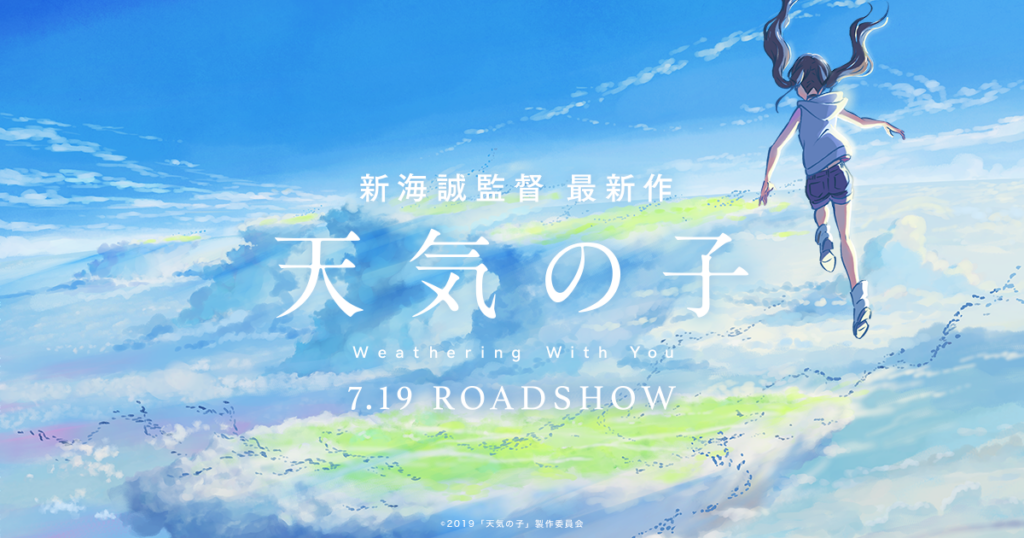
Weathering With You (天気の子, Tenki no Ko, literally “Child of Weather”) is a 2019 Japanese animated romantic fantasy film written and directed by Makoto Shinkai — the celebrated filmmaker behind Your Name (2016) and Suzume (2022). The film is produced by CoMix Wave Films and distributed by Toho, and it forms the second installment of what fans call Shinkai’s “Disaster Trilogy,” following Your Name and preceding Suzume.
It is Makoto Shinkai’s sixth feature-length film and premiered in Japan on July 19, 2019. The film went on to captivate audiences worldwide, earning a 93% approval rating on Rotten Tomatoes from 95 critics, with the site’s consensus describing it as “beautifully animated and narratively engaging,” further establishing Shinkai as a singularly talented filmmaker.
Original Title: 天気の子 (Tenki no Ko)
English Title: Weathering With You
Director / Writer: Makoto Shinkai
Studio: CoMix Wave Films
Distributor: Toho (Japan) / GKIDS (USA)
Release Date: July 19, 2019 (Japan) · January 17, 2020 (USA)
Runtime: 112 minutes (1h 52m)
Music: Radwimps
Voice Cast: Kotaro Daigo (Hodaka), Nana Mori (Hina)
Rotten Tomatoes: 93% | Metacritic: 72/100
Plot Summary — The Story of Hodaka and Hina
A Runaway in the Rain
The summer of his high school freshman year, Hodaka Morishima runs away from his remote island home to Tokyo, quickly finding himself pushed to his financial and personal limits. The weather is unusually gloomy and rainy every day, as if taking its cue from his own life.
On the trip to Tokyo, Hodaka nearly gets thrown overboard during a freak rainstorm on a ferry, but is saved by a man named Keisuke Suga, who offers his business card in case of need. Once in the city, Hodaka struggles to survive — unable to work legally as a runaway minor, he eventually contacts Suga and is hired as an assistant at a small occult publishing company.
Meeting Hina — The Sunshine Girl
Hodaka briefly encounters Hina Amano at a fast-food restaurant where she works; she takes pity on him and gives him a free meal. Later, he watches as Hina is being pressured into working at a sketchy establishment and attempts to rescue her. After the two escape together, Hina reveals her extraordinary ability: she can clear the sky simply by praying.
Inspired by this power, Hodaka proposes that they start a “sunshine business” — Hina using her ability for clients who want clear weather for weddings, outdoor events, and festivals. The venture becomes a great success, attracting clients ranging from kindergarten children to corporate giants.
The Cost of Sunshine ⚠ SPOILERS
Hina calls herself Hare Onna — “The Sun Child.” As the film reveals through folklore and legend, weather maidens appear when there are extreme imbalances in the weather, and their purpose is to restore balance by sacrificing themselves. The more Hina uses her power, the more her body begins to transform — becoming transparent, dissolving into light.
As the rain worsens catastrophically, Hina realizes the only way to stop it and save Tokyo from drowning is to sacrifice herself. She is transported to a magical world above the clouds, where she gradually fades from existence.
Hodaka’s Choice — Love Over the World
At the rooftop shrine, Hodaka jumps through the torii gate and is transported into the sky, where he finds Hina and asks her to return with him — insisting that she let go of her duty and start living for herself.
As soon as they return to the rooftop shrine, all of them are arrested, and the heavy rains resume. Hodaka is sentenced to three years of probation and sent back to his home island. Three years later, the rain has not stopped — much of Tokyo lies submerged. Hodaka, having completed his probation and graduated from high school, returns to Tokyo. After encouragement from Suga, he finds Hina praying on a street overlooking the drowned city, and they reunite — with Hodaka promising her that everything will be all right.
Characters — Who’s Who in Weathering With You
| Character | Role | Voice Actor |
|---|---|---|
| Hodaka Morishima | 16-year-old runaway protagonist. Impulsive, determined, deeply loyal. | Kotaro Daigo |
| Hina Amano | The “Sunshine Girl” / Hare Onna. Orphaned, caring, quietly sacrificial. | Nana Mori |
| Keisuke Suga | Hodaka’s employer. A widowed writer running a small occult magazine. Morally grey mentor figure. | Shun Oguri |
| Natsumi | Suga’s niece and office assistant. Energetic, witty, and fiercely loyal. | Tsubasa Honda |
| Nagi Amano | Hina’s younger brother. Unexpectedly savvy and protective. | Sakura Kiryu |
Themes — What Is Weathering With You Really About?
1. Love vs. Collective Responsibility
The film’s most provocative question is also its simplest: Is one life worth more than an entire city? Hodaka risks the fate of millions just to save Hina’s life — inspiring, touching, heartbreaking, and, by any rational standard, absolutely reckless.
Shinkai refuses to resolve this tension neatly. He does not punish Hodaka for his choice, nor does he frame the drowned Tokyo as a tragedy to be mourned. Instead, the film sits in the uncomfortable space where personal love and social duty are genuinely irreconcilable — and dares the audience to decide which matters more.
2. Climate Change and the Indifference of Nature
All of the characters are forced to confront forces they cannot control. Earlier in the film, an old man tells them that all humans can do is survive at the whims of the weather — and that accepting this is the essence of our existence. The main characters fight that notion throughout: they want to live, to love, and to thrive, regardless of what the world throws at them.
The film introduces a theory that the cataclysmic rainfall is simply part of Earth’s natural climate cycle — not something caused by humanity, and not something humanity can fix. This is a deliberate, even controversial, narrative stance that distinguishes the film from a straightforward climate-change allegory.
3. Youth, Marginalization, and Urban Survival
With Hodaka leaving his remote hometown to move to Tokyo, the film alludes to one of the most pressing social issues in modern Japan: rural exodus. Both Hodaka and Hina are teenagers operating entirely outside the safety nets of adult society — unable to work legally, without stable housing, and ultimately criminalized for simply trying to survive and protect each other.
The film treats young people’s suffering with unusual seriousness. Suga, the adult figure, is himself broken — a widower who has lost his own child, whose moral authority is thoroughly compromised. The teenagers are not saved by adults; they save themselves.
4. Shinto Mythology and the Supernatural
The film contains numerous references to Shinto — Japan’s indigenous religion. The gods in Weathering With You are depicted as impersonally transactional: they demand a sacrifice, offer no mercy, and impose the weather maiden’s fate with cold indifference. This stands in sharp contrast to the warm, intimate love story unfolding in the foreground.
The torii gate on the rooftop shrine functions as a literal threshold between the human world and the divine. Hina uses her power via prayer, and it appears that weather maidens arise specifically when there are extreme imbalances in the natural world — their sacrifice being the price of cosmic equilibrium.
Symbolism — Hidden Layers in Every Frame
Rain as Emotional State
From the very first scene, rain is not simply weather — it is the external expression of Hodaka’s inner world. Tokyo drowns not just literally, but emotionally. The rain mirrors the alienation of youth, the weight of poverty, and the indifference of a city that has no place for those who fall through its cracks.
Conversely, every moment that Hina clears the sky is charged with extraordinary emotional release. Sunshine in this film is not merely pleasant — it is transcendent, almost sacred. Shinkai’s animators render these breaks in the clouds as some of the most visually stunning sequences in any anime film.
Water as Purification and Loss
Water functions throughout the film as a symbol of both purification and renewal — most powerfully in the climactic scene where Hina’s sacrifice brings rain to Tokyo. Yet water is also what ultimately swallows the city when Hodaka chooses to bring Hina back. The same element that cleanses and nourishes is the one that erases and drowns.
The Gun — Actions and Consequences
The gun-shaped cloud formation that appears several times throughout the film symbolizes the idea that our actions carry consequences — and that sometimes those consequences must be faced regardless of how painful they are. The literal gun Hodaka finds early in the film echoes this: a moment of recklessness that shadows every subsequent choice he makes.
The Torii Gate — The Threshold
The rooftop torii gate is the film’s most potent recurring image. In Shinto belief, a torii marks the passage between the mundane world and the sacred. Every time a character passes through it, they are crossing not just a physical boundary but an existential one — choosing to engage with forces larger than themselves, accepting the unknown consequences of that crossing.
Music — Radwimps and the Sound of Rain
As with almost all Shinkai films, the story is told through its music. Shinkai again teamed up with popular Japanese rock band Radwimps to compose the soundtrack — their second collaboration after Your Name.
The instrumental pieces in Weathering With You create a sense of melancholy and longing that fits Shinkai’s themes of separation and distance, as well as the supernatural feeling that arises at critical story moments.
(“Is There Anything Else Love Can Do?”) — Radwimps, Theme Song of Weathering With You
The theme songs — particularly Grand Escape, performed by Toko Miura — function almost as emotional narration, surging at precisely the moments where dialogue would be inadequate. The music doesn’t merely accompany the film; it carries it.
| Track | Moment / Function |
|---|---|
| Voices of the Wind | Captures the rhythm of Hodaka’s new daily routine in Tokyo |
| Ai ni Dekiru Koto wa Mada Aru kai | Main theme — the central love story and its impossible stakes |
| Grand Escape (feat. Toko Miura) | The film’s emotional climax — Hodaka racing to save Hina |
| Is There Still Anything That Love Can Do? | Closing credits — a quiet reckoning with what was lost and found |
The Ending Explained — Did Hodaka Do the Right Thing?
The ending of Weathering With You is deliberately, provocatively unresolved. Many critics and viewers found Hodaka’s decision — saving one girl at the cost of a drowned city — selfish and even immoral. Shinkai himself reportedly expressed concern before release that audiences might be divided by the film’s choices.
The title Weathering With You implies that together, the main characters are fighting the storm. Their power lies in remaining close to each other, no matter what the world demands of them.
Two Ways to Read the Ending
Reading A — Romantic: Hodaka’s choice is an act of radical, unconditional love. In a world that has always marginalized these teenagers, refusing to sacrifice Hina for “society” is the only authentic act of resistance available to them. They choose each other — and that is enough.
Reading B — Critical: The film glamorizes an irresponsible teenager dooming millions because he couldn’t let go. The drowned Tokyo is a consequence the film refuses to fully reckon with, leaving its moral weight uncomfortably unacknowledged.
Both readings are valid — and Shinkai almost certainly intended them both. The film’s power lies precisely in refusing to adjudicate between them. It does not tell you how to feel. It shows you a boy and a girl standing over a half-submerged city and asks: What would you have done?
Weathering With You vs. Your Name — How Do They Compare?
| Category | Your Name (2016) | Weathering With You (2019) |
|---|---|---|
| Core Premise | Body-swapping across time and distance | Weather-controlling girl; love vs. the world |
| Tone | Hopeful, bittersweet, triumphant | Melancholic, morally ambiguous, defiant |
| Ending | Reunion and resolution | Reunion, but the world is permanently changed |
| Animation | Stunning rural and urban Japan | Arguably even more detailed urban Tokyo |
| Music (Radwimps) | Zen Zen Zense, Nandemonaiya | Grand Escape, Ai ni Dekiru Koto wa Mada Aru kai |
| Moral Complexity | Relatively clear-cut heroes and stakes | Deliberately divisive; no easy answers |
| Rotten Tomatoes | 98% | 93% |
Both films were directed by Makoto Shinkai and share overarching themes — the power of love, the consequences of our actions, and the question of how much one person can change the world. Some fans also speculate that the two films exist in the same universe. Indeed, eagle-eyed viewers will spot a brief cameo connecting the two stories.
Animation — A Love Letter to Rainy Tokyo
That large companies like Apple, McDonald’s, and Yahoo! allowed their products to be rendered in meticulous detail within the film is a sign of how far Makoto Shinkai’s cultural prestige had grown. Every puddle, every neon reflection, every strand of rain-soaked hair is rendered with extraordinary care.
The film’s real-world Tokyo locations — Shinjuku, Yoyogi, Tabata — are recreated with near-photographic accuracy. The abandoned Yoyogi Kaikan building that serves as a key location in the film was actually demolished in January 2020, shortly after the movie’s release, making the film an inadvertent historical document of a Tokyo that no longer exists.
Shinkai’s animators treat rain itself as a character — a living, breathing presence. The way light refracts through falling drops, the way puddles ripple, the way clouds part to release a single beam of gold onto a grey city — these sequences alone justify the film’s place among the greatest animated works of the 21st century.
Legacy and Cultural Impact
Weathering With You was a massive commercial success, grossing over ¥14 billion (approximately $130 million USD) at the Japanese box office and performing strongly internationally. It won the Japan Academy Film Prize for Animation of the Year (2020) and cemented Shinkai’s place alongside Studio Ghibli’s Hayao Miyazaki as one of the defining voices of Japanese animation.
More than its box-office numbers, however, the film sparked genuine cultural debate. In Japan and beyond, audiences argued passionately about Hodaka’s choice — in classrooms, online forums, and film journals. That a mainstream anime film could provoke that level of ethical engagement is itself a remarkable achievement.
For younger Japanese viewers in particular, the film’s portrait of precarious urban youth — working illegally, homeless, invisible to institutions — resonated deeply with real anxieties about a society that often has no place for those who don’t fit its expectations.
Final Verdict — Should You Watch Weathering With You?
A film that asks the questions no one wants to answer
Weathering With You is not the easiest Shinkai film, nor the most immediately satisfying. It will frustrate you. Its protagonist makes choices you may find indefensible. Its ending gives you a drowned city instead of a clean resolution.
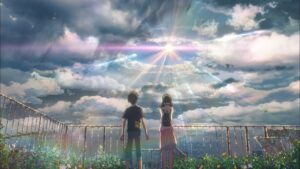
And yet — it stays with you. The rain stays with you. Hina’s smile, breaking through clouds, stays with you. The image of two teenagers standing over a submerged Tokyo, holding hands, promising each other that they’ll be all right — that stays with you most of all.
This is a film about what it means to love someone in a world that is already past saving. It doesn’t offer comfort. It offers something rarer: the truth that sometimes, choosing one person over everything else is the most human thing you can do.
▶ New to Shinkai? Start with Your Name, then watch Weathering With You — the contrast between their endings will tell you everything about how his vision evolved.
▶ Already a fan? Rewatch with the audio commentary and look for the Your Name cameo in the closing sequences.







コメント